Bernician Studies Group Meeting, 5 February 2026 at the Tyneside Irish Centre, Gallowgate, Newcastle (by Rannoch Daly)
Topic: Ancient Woodland: Hanging Leaves Wood
In 1066 Cospatric was earl of Bernicia. He was deposed by William the Conqueror in 1072 and replaced by Waltheof of York. Cospatric fled to Scotland where he was appointed earl of Dunbar by King Malcolm III. He died the following year and was succeeded by his son Cospatric II. Around 1085 the Conqueror granted William du Merlay the barony of Morpeth. Probably around 1113 AD du Merlay’s son Ranulf married Juliana, daughter of Cospatric II, and she brought with her, as a dowry, considerable lands between Morpeth and Brinkburn (See Juliana and Ranulf of Morpeth Castle by Bridget Gubbins 2016).
[Note by Max Adams: The townships of Juliana’s estate have survived largely intact (shades of brown in the map below). Together with the course of the River Lyne, itself a boundary of estates (shaded yellow in the map below) first recorded in the 8th century, they form a continuous boundary feature rising in the Pennines and running some 30km to the sea at Lynemouth – highlighted in purple on the map below.]
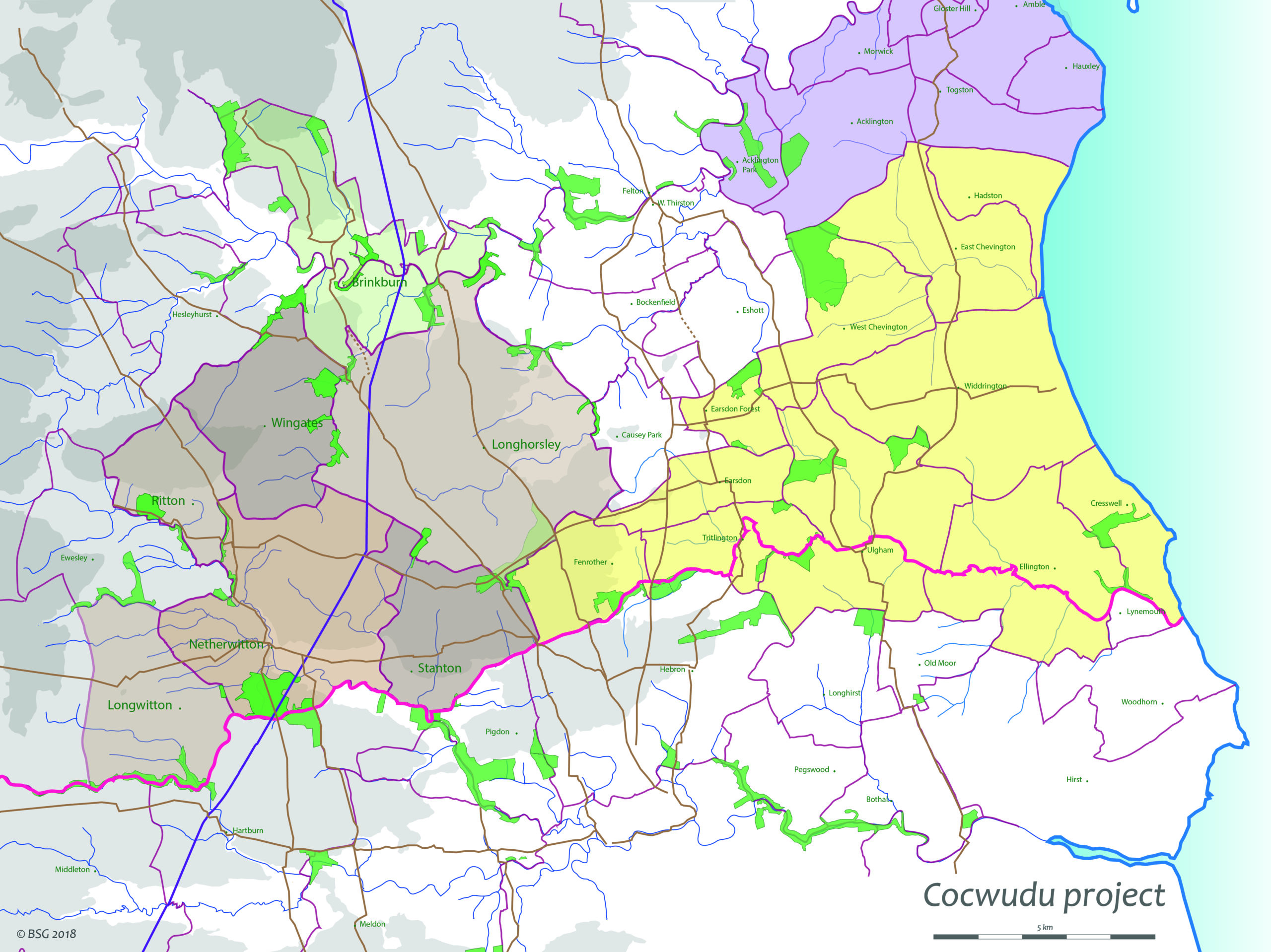
Hanging Leaves Wood sits east of the lands of Juliana; its northern edge coincides with the major estates boundary. Max Adams and Colm O’Brien outlined the history of the area and its relationship to surrounding lands, concentrating on ancient charters, routeways, drove roads, estate boundaries, etc. There is a prominent ditch and embankment facing north from Hanging Leaves Wood (in the map below it is shown on a composite OS 1st Edition and LiDAR plot: where red dots and yellow lines coincide).
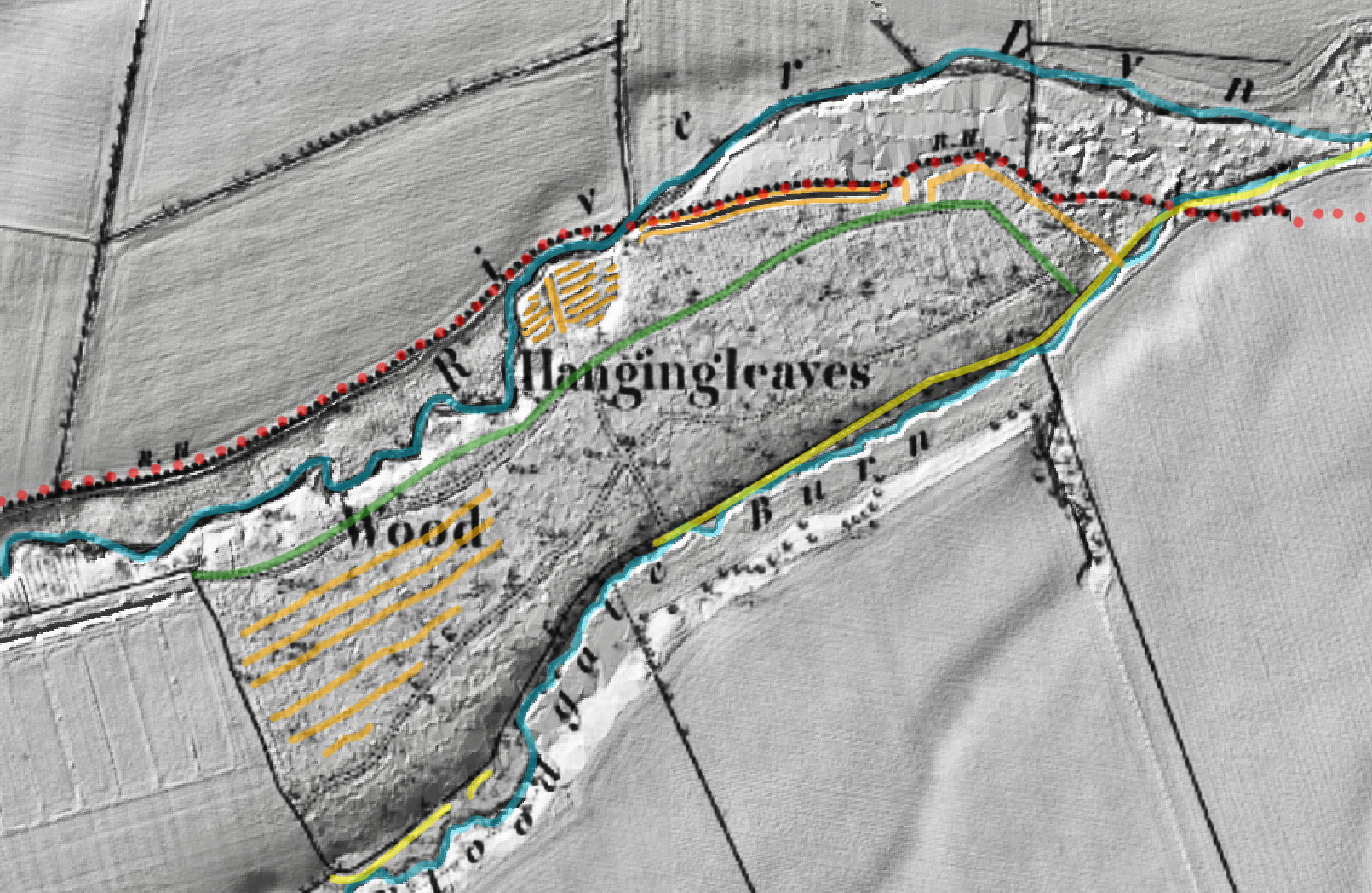
Is it possible to establish whether this ditch/embankment was constructed in the time of Juliana, or earlier, or later? Can we learn more about its original scale and purpose?
Dorothy Cowans outlined plans to use Optically Stimulated Luminescence (OSL) to investigate the structure and antiquity of this woodland landscape feature. [note from Max Adams: OSL allows a date to be obtained from soil profiles buried beneath the banks of ancient earthworks.] Read Dorothy’s 2025 report on the plants of Northumberland’s ancient woodland in her article “The Use of Indicator Species in Identifying Ancient Woodland in South-East Northumberland” (see the BSG publications tab).
Next meeting 19 February 2026
Topics:
1 – Place-names ending in ‘-ton’: Do they form ‘purposeful clusters’?
2 – Ancient handwriting: What is Biblical ‘majuscule’? What is Caroline minuscule? Can you tell them apart? A look at the work of the medieval scribes.