by Rannoch Daly
Colm O’Brien introduced the handwriting of 8th century Northumbrian documents.
We examined the scripts of four documents written with two different scripts:
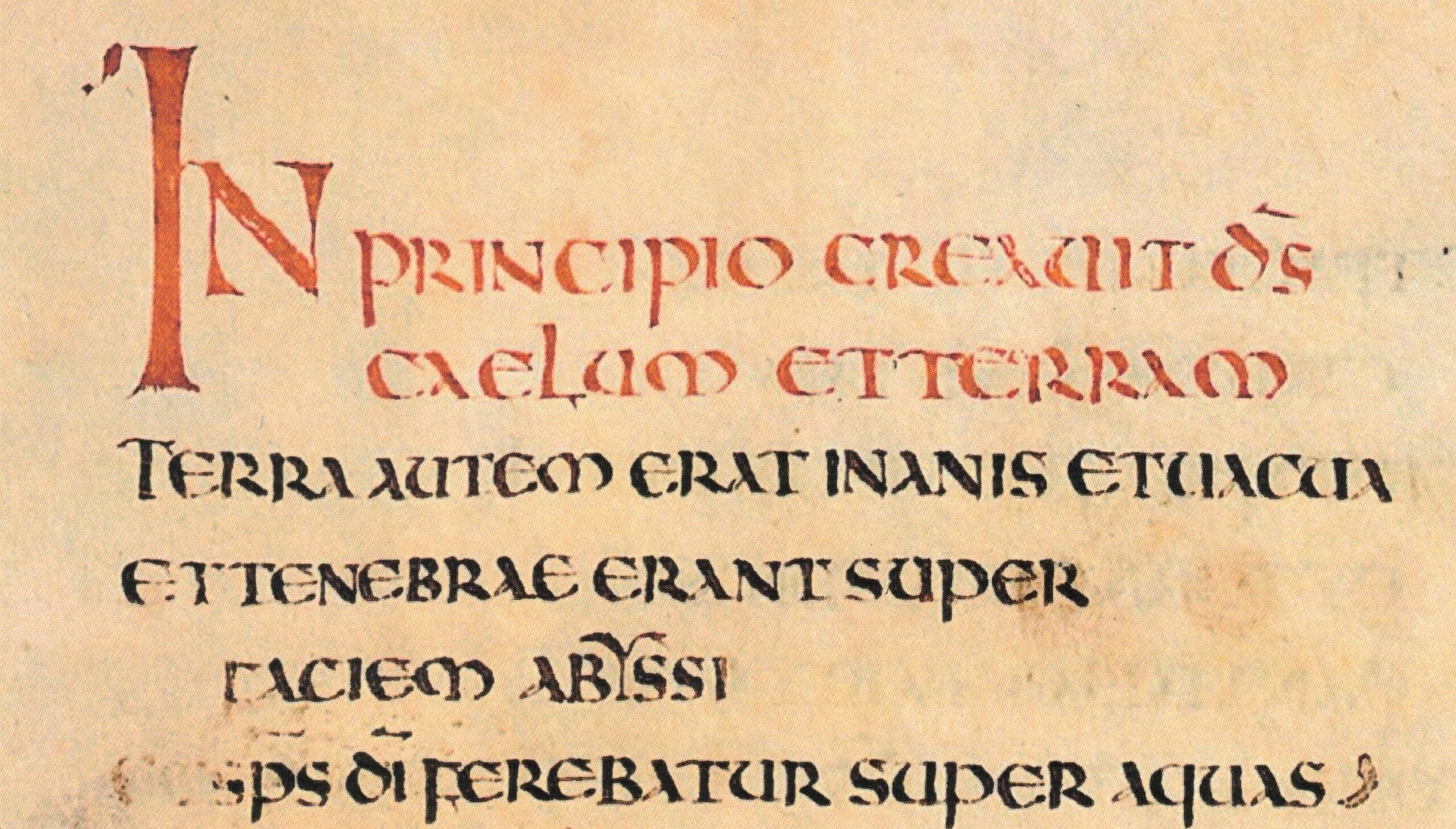
Uncial; the Codex Amiatinus (1) – above – and the Evangelia Cantuariensia (2);
Insular Majuscule; the Durham Gospels (3) – below – and the Codex Lindisfarnensis (4).
We focussed on how different scripts formed their letters in different ways.
The two images here are illustrative extracts with transcription, translation and a few notes.
(1) The Codex Amiatinus was written in Jarrow and taken to Rome as a gift for Pope Gregory II in 716 AD. It is now in the Biblioteca Laurenziana in Florence.
(2) The Evangelia Cantuariensis (Gospel of St Augustine) is believed to have come from Italy with Augustine on his mission from Pope Gregory I in 597 AD. It is now in Corpus Christi College Cambridge (MD 286).
(3) The Durham Gospels were written in Lindisfarne ca. 700 AD. It is now in Durham Cathedral (A.II.17).
(4)The Codex Lindisfarnensis (Lindisfarne Gospels) was written in Lindisfarne ca. 715 AD. It is now in the British Museum (Cotton MS Nero D IV)
Item 1, the Codex Amiatinus (f. 11r), (image above) is written in Uncial script. This extract is from Genesis I.1-2.
Transcription: ‘In principio creavit ds [deus] caelum et terram terra autem erat inanis et vacua et tenebrae erant super faciem abyssi et sps di ferebatur super aquas.’
Translation: ‘In the beginning God created the heaven and the earth. And the earth was without form, and void; and darkness was upon the face of the deep: and the Spirit of God moved upon the waters.’
Note:
1 – the original has no punctuation.
2 – ‘ds’ is a common Latin abbreviation for ‘deus’ [god]; as is ‘sps di’ for ‘Spirit of God’
3 – The word ‘vacua’: modern printed Latin uses the letters ‘u’ and ‘v’ but the original script gave both letters the same shape ‘u’.
4 – Latin does not have the letter ‘y’. In the word ‘abyssi’ [the deep] the letter ‘y’ is borrowed from the Greek letter ‘epsilon’.
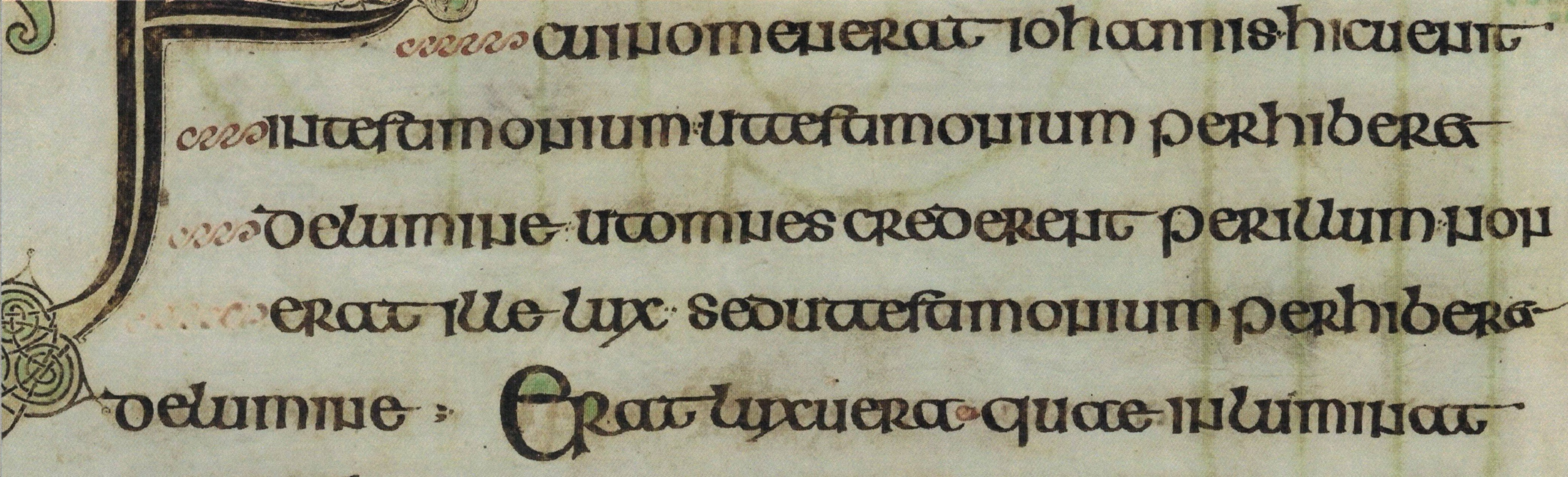
Item 2, the Durham Gospels (f. 2v), is Insular Majuscule script. This extract is from John I.6-8.
Transcription: ‘ . . . cui nomen erat johannis hic venit in testimonium ut testimonium perhiberet de lumine ut omnes crederent per illum non erat ille lux sed ut testimonium perhiberet de lumine.’
Translation: ‘ . . . whose name was John. He came as a witness, to bear witness of the Light, that all men through him might believe. He was not that Light but was sent to bear witness of that light.’
Note: At the end of the word ‘perhiberet’ the letters ‘et’ are run together to form a ‘ligature’.
Next Meeting: 18 June 2026
Topics:
1 – More on early writing
2 – A discussion about the focus of our activities next year and onwards.
All welcome – especially the inquisitive!